

|
Back to TWELVE generations ago < 1700 |
1775 |
Forward to EIGHT generations ago 1800 > |
| NINE generations ago | ||
|---|---|---|
|
For centuries, most people in Britain had lived and worked in the countryside, on farms owned by a few rich landowners. Cities were little more than villages. But this was about to change.
The Agricultural Revolution 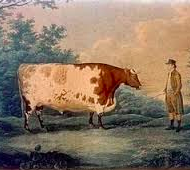 Some landowners turned to science to try to improve ancient farming methods on their farms. 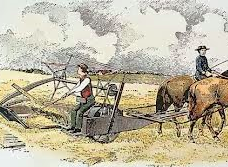 Some tried changing their crops or breeding bigger animals to produce more food. Others invented new machines – the seed drill (1700), spinning jenny (1764) – that worked much faster than people, and made them very rich. |
||
| Industrial revolution Instead of families being paid to weave pieces of cloth at home, new weaving machines in factories turned tons of cotton and wool into cloth every day. People left villages to work in factories, around which towns began to grow. House building and brick making boomed. Coal became more popular than wood as fuel, and the first steam engines were invented to pump water out of the mines. Coal was also vital for a new blast furnace that produced iron on a much bigger scale than ever before. Iron was used at first to make cheap pots, pans and kettles, but soon found other uses, such as more new steam engines to power factories and to mine for more coal to work the steam engines … Britain’s age of machines known as the industrial revolution had started. |
||
heading 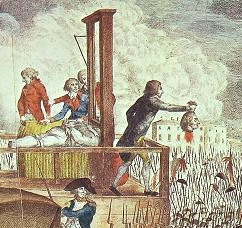
|
||
| *** PAGE STILL UNDER DEVELOPMENT *** |
||
|
World Exploration Britain’s empire in America, Africa, and India – and the trade in slaves – was growing, and depended on British ships being better than the rest of the world. Many ships were lost in the ocean until two British inventions, the sextant (1757) and maritime clock (1761), enabled ships to calculate their exact position in the world. With better maps, sailors could explore distant oceans, leading in 1770 to Captain Cook’s discovering Australia. |
|
Revolutions in America and France In Britain’s colonies in America, angry landowners decided that they no longer wanted to be part of Britain. They started a war against Britain, declaring that their country was now independent, and called the United States of America (1779). Meanwhile in France, King Louis called together his advisors to approve some tax rises, but instead of agreeing,
they overthrew him (1789), plunging France into violent revolution. For the next five years (known as "The Terror"), the infamous Guillotine chopped of tens of thousands of people's heads, of anyone that might disagree with the revolution, especially of anyone rich or powerful.
|
| *** PAGE STILL UNDER DEVELOPMENT *** |
layer 4
layer 4a
 layer 4b
layer 6
 layer 6a
layer 7